





By | Kamra Ashraf Bhat
On a frigid March evening, as the Himalayan winds howled through the valley, a desperate struggle was underway in Karnah. Roads had vanished under thick sheets of snow. Electricity had succumbed to the elements. And in a morgue miles away in Kupwara, the lifeless bodies of locals waited—delayed not by bureaucracy, but by the unforgiving terrain that held them hostage.
At the heart of the response was a soldier who refused to wait for the weather to change. Colonel Sudeep Bose, Deputy Commander of the 104 Shakti Vijay Brigade, was not content with issuing orders from headquarters. He knew that leadership meant walking the road yourself—even when the road was buried under feet of ice.
A Valley Cut Off, A Mission Unfolds
For the residents of Karnah, nestled near the Line of Control, winter is not just a season; it is a test of endurance. The region, often blanketed under heavy snowfall, remains at the mercy of both nature and geopolitics. This time, the storm had been particularly ruthless. The arterial NH-701, the lifeline connecting Karnah to the rest of Kashmir, lay crippled under heavy drifts of snow and frequent avalanches.
The Power Development Department (PDD) struggled to reach Nasta Chhun Pass—locally known as NC Pass—to restore the valley’s electricity. But with roads buried and temperatures plunging, each hour without power meant worsening conditions for those dependent on it. That’s when Col. Bose stepped in.
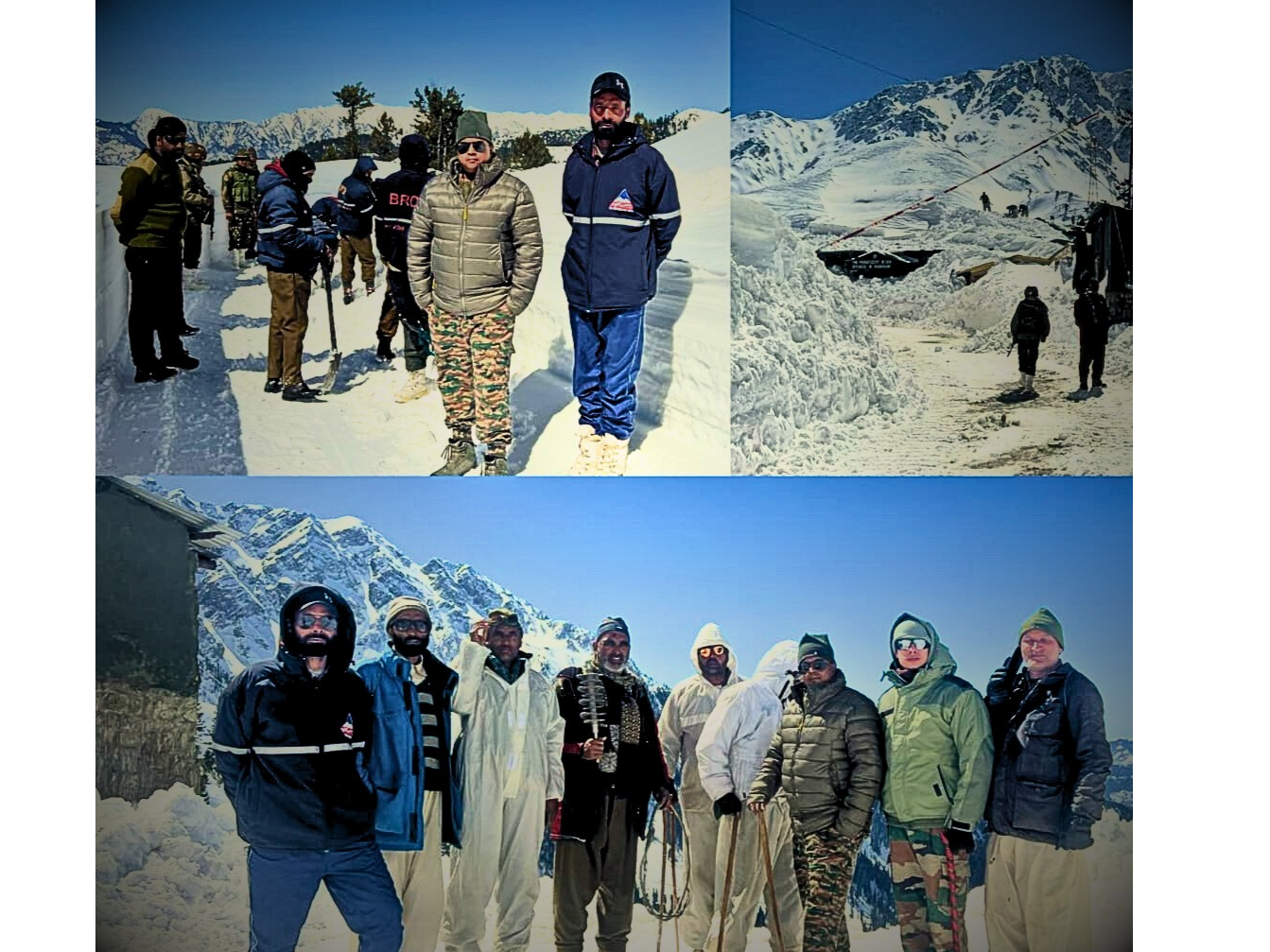
With military precision, he coordinated an intervention that was as much about logistics as it was about resilience. Soldiers under his command facilitated the movement of PDD teams to the pass, ensuring that the restoration work could begin without further delay. Simultaneously, he set out himself to inspect the NH-701 clearance operations—traveling over 60 kilometers from Karnah to Chowkibal, through some of the most treacherous conditions imaginable.
But his journey was more than an operational review. At Sadhna Top, where the snow piles higher than a man and the winds threaten to unmoor even the strongest, he walked the path of the machines and the men clearing it. His presence was a signal—not just to his troops but to the civilians watching from their snowed-in homes. This was not just a clearance operation; it was a promise that their isolation would not last forever.
In the military, operations are often measured in objectives met. But for the people of Karnah, this mission was measured in the warmth of light bulbs flickering back to life, in the rumble of engines on a once-silent road, and in the solemn dignity of bodies finally returning home from Kupwara for their last rites.
This is the paradox of military presence in regions like Karnah—a force trained for combat often finds itself at the frontlines of humanitarian relief. The Army’s interventions here are not about conflict; they are about survival. The men clearing the roads with snow cutters are not wielding rifles, but rather tools that bring life back to a stranded valley.
Yet, the divide between military and civilian life remains complex. The Army’s omnipresence in Kashmir is a subject of both gratitude and scrutiny. In moments of crisis, like this one, they are saviors. But in times of political unrest, their presence sparks tension. Deputy Commander of the 104 Shakti Vijay Brigade’s efforts, then, reflect a broader reality: the soldier’s role in Kashmir is neither solely that of a protector nor an enforcer, but of someone navigating the liminal space between both.
Winter will come again, and so will the snows that erase roads and cut off villages. The struggle to maintain connectivity is not just seasonal—it is perpetual. For every clearance operation, there are lives at risk—both of those waiting for help and those delivering it.
Deputy Commander’s night journey across Sadhna Top was not without peril. Avalanches remain unpredictable. The terrain itself is a living, shifting force, swallowing paths as quickly as they are carved out. But for him, and for the men following in his wake, the risks were secondary. The mission was primary.
For the people of Karnah, the restoration of power and roads is more than just a return to normalcy. It is a reassurance that they are not forgotten. And for Col. Sudeep Bose, the journey through the snow was more than a duty. It was a statement—a silent but resolute one—that leadership, at its best, means leading from the front.
About Writer : Kamran Ashraf Bhat is the CEO and Director News at The Spotlight. As a Journalist, his work delves into socio-political and socio-religious issues, history, and film theory. A graduate of Bahçeşehir University in Istanbul, Türkiye, he specialized in comparative analyses of film and media, drawing on the theories of Stuart Hall, the British Marxist sociologist and cultural theorist, as well as Noam Chomsky, the renowned American linguist and political thinker. His research explores the intersection of media, ideology, and societal structures, offering a critical lens on contemporary discourse.