






By | Danish Naseer
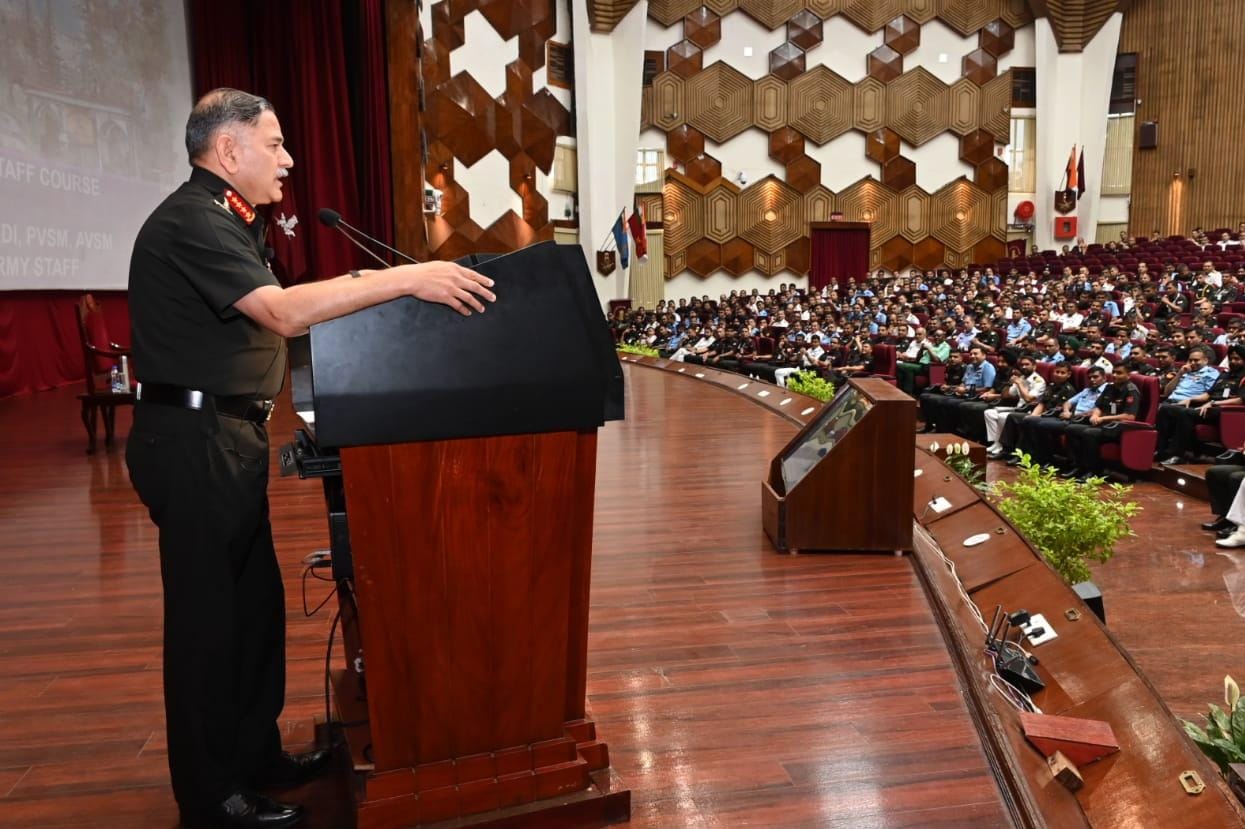
New Delhi: In a significant address that underscores the future of India’s military strategy, Chief of Army Staff (COAS) General Upendra Dwivedi emphasized the need for enhanced jointness and synergy among the three branches of the Indian Armed Forces. Speaking at the Defence Services Staff College (DSSC), Wellington, he highlighted the evolving nature of warfare, emerging security threats, and the necessity of adaptability in modern military operations.
Delivering a keynote address to student officers undergoing the 80th Staff Course and the permanent faculty at DSSC, Gen Dwivedi lauded the institution’s critical role in shaping India’s future military leadership. He stressed that inter-service cooperation, technological advancements, and strategic foresight are essential in ensuring that India remains prepared for any future conflicts.
With warfare undergoing rapid technological and strategic transformations, Gen Dwivedi pointed out that jointness and integration among the Army, Navy, and Air Force are no longer optional but a necessity. He highlighted how modern conflicts require seamless coordination between the three services to counter multi-domain threats effectively.
“The nature of warfare is constantly evolving, with new technologies, cyber warfare, artificial intelligence, and space-based operations reshaping military doctrines worldwide. To ensure India’s security, we must strengthen our ability to fight as one cohesive force, leveraging the strengths of each service while fostering interoperability,” the COAS stated.
Gen Dwivedi urged officers to think beyond traditional battlefields and prepare for hybrid and multi-domain warfare, where challenges could arise from land, sea, air, space, and cyberspace simultaneously. He stressed the importance of real-time intelligence, rapid decision-making, and strategic coordination, stating that future wars will be won not just by individual service excellence, but through collective synergy and unified operational effectiveness.
Recognizing the Defence Services Staff College (DSSC) as a premier institution for professional military education, the Army Chief commended its contribution to grooming India’s future military leaders. He noted that DSSC plays a pivotal role in preparing officers to adapt to the dynamic security environment and hone their decision-making, strategic planning, and operational capabilities.
During his visit, the COAS was briefed by DSSC Commandant Lt Gen Virendra Vats on how the curriculum is being tailored to align with the challenges of future wars. A major highlight of this effort is the introduction of the first Deep Purple Division, wherein 40 tri-services officers have undergone specialized training to enhance their ability to operate jointly across different domains.
“Training future military leaders to operate jointly in integrated combat environments is key to our national security strategy. DSSC’s efforts in this direction are commendable, and I am confident that officers trained here will play a decisive role in shaping India’s military future,” Gen Dwivedi remarked.
He also emphasized the importance of innovation and technology integration in military planning, urging young officers to embrace emerging technologies such as artificial intelligence, cyber warfare capabilities, and electronic warfare systems to maintain a strategic edge.
Apart from addressing the officers and faculty, Gen Dwivedi took time to interact with veterans of the Wellington Military Station, acknowledging their unparalleled service and sacrifices for the nation. In recognition of their contributions, he conferred the ‘Veteran Achievers Award’ to distinguished ex-servicemen who have continued to serve the country in various capacities post-retirement.
“Our veterans are the backbone of our armed forces’ legacy. Their experience, wisdom, and dedication continue to inspire the next generation of military leaders. It is our duty to honor and learn from their invaluable service to the nation,” he stated.
Gen Dwivedi’s visit to DSSC and his emphasis on joint operations, technological advancements, and adaptive leadership reflect the Indian Army’s long-term vision for military transformation. As geopolitical challenges grow more complex, his call for greater synergy among the armed forces aligns with India’s broader defense strategy to enhance preparedness and operational effectiveness.
His address also signals the importance of continuous modernization in India’s military approach, ensuring that officers are not only equipped with conventional warfighting skills but are also adept at handling hybrid, cyber, and space-based conflicts.
With the world witnessing rapid advancements in military technology, artificial intelligence, and information warfare, Gen Dwivedi’s message serves as a strategic call to action—urging India’s armed forces to remain at the forefront of innovation, collaboration, and combat readiness.
As India faces a complex and evolving security landscape, the need for seamless integration, technological adaptation, and strong leadership has never been more critical. The Indian Armed Forces, under the guidance of leaders like Gen Upendra Dwivedi, continue to move towards a future-ready force, capable of defending the nation against any emerging threats.