
• About
  • Advertise
  • Careers
  • Contact
Thursday, May 14, 2026
The Spotlight
No Result
View All Result
  • Home
  • News
    • All
    • Art
    • Business
    • Entertainment
    • Environment
    • Jammu and Kashmir
    • Lifestyle
    • National
    • Politics
    • Sports
    • World
    Indian Army & School Children Lead Powerful ‘Nasha Mukt Bharat Abhiyan’ in Keran Bowl

    Indian Army & School Children Lead Powerful ‘Nasha Mukt Bharat Abhiyan’ in Keran Bowl

    Market Checking Intensified in Lolab

    Market Checking Intensified in Lolab

    Market Checking Drive Conducted at Sogam to Ensure Fair Practices During Ramzan

    Market Checking Drive Conducted at Sogam to Ensure Fair Practices During Ramzan

    SKIMS Hosts Official Pre-Summit of India AI Impact Summit 2026

    SKIMS Hosts Official Pre-Summit of India AI Impact Summit 2026

    SDH Kup Controversy: Mockery of Journalism, Medical Services 

    SDH Kup Controversy: Mockery of Journalism, Medical Services 

    Keran Mark Indian Armed Forces Veterans’ Day, Army Day with Patriotic Fervour

    Keran Mark Indian Armed Forces Veterans’ Day, Army Day with Patriotic Fervour

    Preparatory Meeting Held at Lalpora to Review Republic Day 2026 Arrangements

    Preparatory Meeting Held at Lalpora to Review Republic Day 2026 Arrangements

    GDC Banihal Distributes LIC Appointment Letters Under Mission YUVA

    GDC Banihal Distributes LIC Appointment Letters Under Mission YUVA

    No Legal Authority Exists to Restrict Journalists, RTI Reveals But Ambiguity Persists in Kashmir

    No Legal Authority Exists to Restrict Journalists, RTI Reveals But Ambiguity Persists in Kashmir

  • Multimedia
    • All
    • Documentary
    • Interview
    • Photography
    • Podcast
    Bridging Borders: Young Ambassadors Witness Life at the Edge

    Bridging Borders: Young Ambassadors Witness Life at the Edge

    Mehdi and Bassem Podcast on middle East war

    Mehdi and Bassem Podcast on middle East war

    Architectural Marvels of the Olympics: A Century of Iconic Designs

    Architectural Marvels of the Olympics: A Century of Iconic Designs

    Howard Caldwell’s Interview with Indira Gandhi

    Howard Caldwell’s Interview with Indira Gandhi

    Kashmir in Frames

    Kashmir in Frames

    Documentary: Losing Paradise

    Documentary: Losing Paradise

  • Opinion
    • All
    • Editorial
    • Guest Essays
    SDH Kup Controversy: Mockery of Journalism, Medical Services 

    SDH Kup Controversy: Mockery of Journalism, Medical Services 

    Journalism Cannot Be Licensed, Even in the Name of Legitimacy

    Journalism Cannot Be Licensed, Even in the Name of Legitimacy

    Catalyst for Social Growth in Karnah

    Catalyst for Social Growth in Karnah

    Official Mockery in Karnah: When CMO and BMO Become Judge, Jury, and Executioner

    Official Mockery in Karnah: When CMO and BMO Become Judge, Jury, and Executioner

    A Shattered Dream

    A Shattered Dream

    Opinion: A Living Bond of Security and Solidarity

    Opinion: A Living Bond of Security and Solidarity

    Editorial: Mob Justice by Cops, Media Without Spine

    Editorial: Mob Justice by Cops, Media Without Spine

    Editorial: Holding the Line against Terror

    Editorial: Holding the Line against Terror

    WHY SELECTIVE CENSORSHIP?

    WHY SELECTIVE CENSORSHIP?

  • Spotlight Special
    Journalism Cannot Be Licensed, Even in the Name of Legitimacy

    Journalism Cannot Be Licensed, Even in the Name of Legitimacy

    Official Mockery in Karnah: When CMO and BMO Become Judge, Jury, and Executioner

    Official Mockery in Karnah: When CMO and BMO Become Judge, Jury, and Executioner

    RTI Reveals Bandipora–Lolab Road Was Never Approved

    RTI Reveals Bandipora–Lolab Road Was Never Approved

    A Shattered Dream

    A Shattered Dream

    Antalya Diplomacy Forum Calls for Reclaiming Global Order

    Antalya Diplomacy Forum Calls for Reclaiming Global Order

    بےلگام صحافت  اورسوشل میڈیا

    بےلگام صحافت اورسوشل میڈیا

    Kupwara Accidents: Facebook Savages and the Breakdown of Boundaries for Likes and Views 

    Kupwara Accidents: Facebook Savages and the Breakdown of Boundaries for Likes and Views 

    Political Showdown in J&K  Over Waqf Bill: Omar Abdullah, Mehbooba Mufti Trade Blows

    Political Showdown in J&K  Over Waqf Bill: Omar Abdullah, Mehbooba Mufti Trade Blows

    Unparliamentary Parliamentarian

    Unparliamentary Parliamentarian

  • About Us
  • Contact Us
  • Home
  • News
    • All
    • Art
    • Business
    • Entertainment
    • Environment
    • Jammu and Kashmir
    • Lifestyle
    • National
    • Politics
    • Sports
    • World
    Indian Army & School Children Lead Powerful ‘Nasha Mukt Bharat Abhiyan’ in Keran Bowl

    Indian Army & School Children Lead Powerful ‘Nasha Mukt Bharat Abhiyan’ in Keran Bowl

    Market Checking Intensified in Lolab

    Market Checking Intensified in Lolab

    Market Checking Drive Conducted at Sogam to Ensure Fair Practices During Ramzan

    Market Checking Drive Conducted at Sogam to Ensure Fair Practices During Ramzan

    SKIMS Hosts Official Pre-Summit of India AI Impact Summit 2026

    SKIMS Hosts Official Pre-Summit of India AI Impact Summit 2026

    SDH Kup Controversy: Mockery of Journalism, Medical Services 

    SDH Kup Controversy: Mockery of Journalism, Medical Services 

    Keran Mark Indian Armed Forces Veterans’ Day, Army Day with Patriotic Fervour

    Keran Mark Indian Armed Forces Veterans’ Day, Army Day with Patriotic Fervour

    Preparatory Meeting Held at Lalpora to Review Republic Day 2026 Arrangements

    Preparatory Meeting Held at Lalpora to Review Republic Day 2026 Arrangements

    GDC Banihal Distributes LIC Appointment Letters Under Mission YUVA

    GDC Banihal Distributes LIC Appointment Letters Under Mission YUVA

    No Legal Authority Exists to Restrict Journalists, RTI Reveals But Ambiguity Persists in Kashmir

    No Legal Authority Exists to Restrict Journalists, RTI Reveals But Ambiguity Persists in Kashmir

  • Multimedia
    • All
    • Documentary
    • Interview
    • Photography
    • Podcast
    Bridging Borders: Young Ambassadors Witness Life at the Edge

    Bridging Borders: Young Ambassadors Witness Life at the Edge

    Mehdi and Bassem Podcast on middle East war

    Mehdi and Bassem Podcast on middle East war

    Architectural Marvels of the Olympics: A Century of Iconic Designs

    Architectural Marvels of the Olympics: A Century of Iconic Designs

    Howard Caldwell’s Interview with Indira Gandhi

    Howard Caldwell’s Interview with Indira Gandhi

    Kashmir in Frames

    Kashmir in Frames

    Documentary: Losing Paradise

    Documentary: Losing Paradise

  • Opinion
    • All
    • Editorial
    • Guest Essays
    SDH Kup Controversy: Mockery of Journalism, Medical Services 

    SDH Kup Controversy: Mockery of Journalism, Medical Services 

    Journalism Cannot Be Licensed, Even in the Name of Legitimacy

    Journalism Cannot Be Licensed, Even in the Name of Legitimacy

    Catalyst for Social Growth in Karnah

    Catalyst for Social Growth in Karnah

    Official Mockery in Karnah: When CMO and BMO Become Judge, Jury, and Executioner

    Official Mockery in Karnah: When CMO and BMO Become Judge, Jury, and Executioner

    A Shattered Dream

    A Shattered Dream

    Opinion: A Living Bond of Security and Solidarity

    Opinion: A Living Bond of Security and Solidarity

    Editorial: Mob Justice by Cops, Media Without Spine

    Editorial: Mob Justice by Cops, Media Without Spine

    Editorial: Holding the Line against Terror

    Editorial: Holding the Line against Terror

    WHY SELECTIVE CENSORSHIP?

    WHY SELECTIVE CENSORSHIP?

  • Spotlight Special
    Journalism Cannot Be Licensed, Even in the Name of Legitimacy

    Journalism Cannot Be Licensed, Even in the Name of Legitimacy

    Official Mockery in Karnah: When CMO and BMO Become Judge, Jury, and Executioner

    Official Mockery in Karnah: When CMO and BMO Become Judge, Jury, and Executioner

    RTI Reveals Bandipora–Lolab Road Was Never Approved

    RTI Reveals Bandipora–Lolab Road Was Never Approved

    A Shattered Dream

    A Shattered Dream

    Antalya Diplomacy Forum Calls for Reclaiming Global Order

    Antalya Diplomacy Forum Calls for Reclaiming Global Order

    بےلگام صحافت  اورسوشل میڈیا

    بےلگام صحافت اورسوشل میڈیا

    Kupwara Accidents: Facebook Savages and the Breakdown of Boundaries for Likes and Views 

    Kupwara Accidents: Facebook Savages and the Breakdown of Boundaries for Likes and Views 

    Political Showdown in J&K  Over Waqf Bill: Omar Abdullah, Mehbooba Mufti Trade Blows

    Political Showdown in J&K  Over Waqf Bill: Omar Abdullah, Mehbooba Mufti Trade Blows

    Unparliamentary Parliamentarian

    Unparliamentary Parliamentarian

  • About Us
  • Contact Us
No Result
View All Result
The Spotlight
No Result
View All Result
Home Opinion

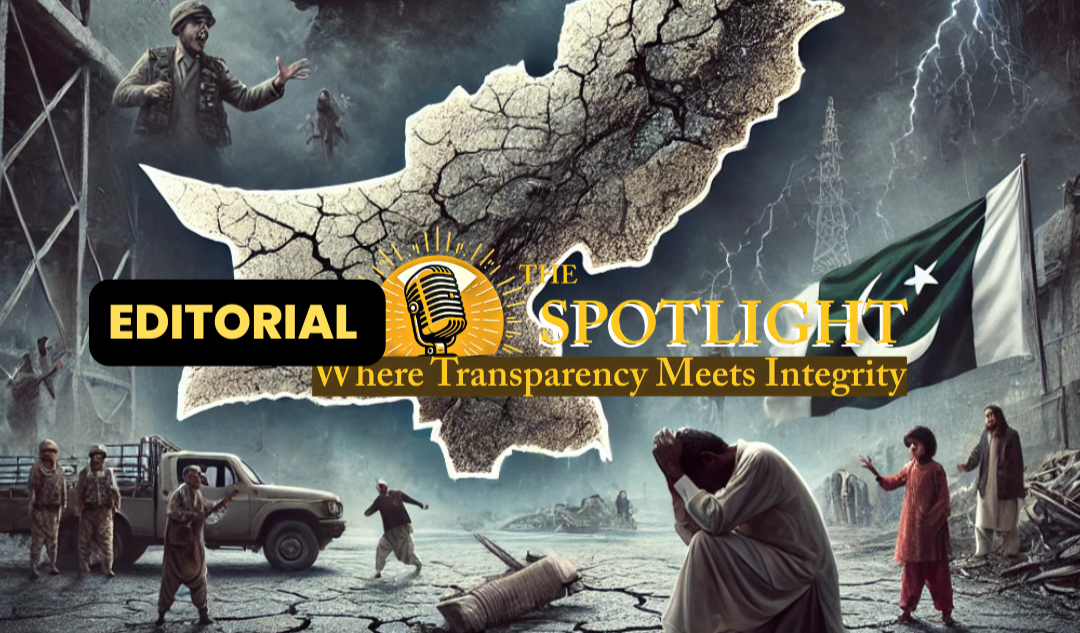
Why Pakistan Fails: An Analysis Based on Why Nations Fail

How Military Domination, Political Elitism, and Economic Exclusion Perpetuate a Cycle of Dysfunction

by thespotlight_webdesk
February 18, 2025
in Opinion, Politics, Spotlight Special, World
0
Why Pakistan Fails: An Analysis Based on Why Nations Fail
0
SHARES
222
VIEWS
Share on FacebookShare on TwitterShare On WhatsApp

By | Kamran Ashraf Bhat 


Pakistan is a paradox. A country forged in the fiery crucible of independence, brimming with potential, yet perpetually teetering on the edge of collapse. Its story is one of unfulfilled promises, squandered opportunities, and a relentless cycle of dysfunction. To understand why Pakistan fails, one need look no further than the framework laid out in Why Nations Fail by Daron Acemoglu and James Robinson. The book’s central thesis—that nations fail when they are governed by extractive institutions designed to benefit a narrow elite at the expense of the many—fits Pakistan like a glove. Pakistan is not poor because of geography, culture, or some inherent flaw in its people. It is poor because its institutions are engineered to keep it that way. The country is a textbook example of how extractive political and economic systems create a self-reinforcing cycle of stagnation, inequality, and instability.

At the heart of Pakistan’s dysfunction lies its extractive institutions. These are not accidental or incidental; they are deliberate constructs, carefully maintained by a ruling elite that includes military generals, feudal landlords, and political dynasties. The Pakistani military is not just a defender of the nation; it is a bloated, parasitic entity that has hijacked the country for its own benefit. It operates as a corporate empire, siphoning billions through business conglomerates spanning real estate, manufacturing, and media. It dictates foreign policy with reckless abandon, nurturing extremist proxies to justify its bloated existence while stifling democracy at home. Every civilian government that dares to challenge its supremacy is either toppled in a coup or neutered through judicial manipulation and media control. Pakistan does not have a government with a military; it has a military with a subservient government.

In rural Pakistan, feudalism is alive and well. A small class of landowners controls vast estates, while millions of peasants toil in conditions little better than serfdom. These landlords wield immense political power, often serving as lawmakers who block any legislation that might threaten their privileges. Land reform? A non-starter. Taxation of agricultural income? Forget it. The feudal elite ensures that the rural economy remains stagnant, trapping millions in poverty. But even this feudal structure bows to the military, which dictates the limits of civilian governance. Pakistan’s political parties are less about ideology and more about family businesses. The Bhuttos, the Sharifs, and the Chaudhrys dominate the landscape, treating politics as a hereditary right. Elections are often rigged, and governance is reduced to a game of patronage, where loyalty is rewarded with jobs, contracts, and favors. However, none of these political dynasties dare to challenge the military head-on, for they know that defiance invites swift retribution.

Inclusive institutions, as Acemoglu and Robinson argue, are the bedrock of prosperous nations. They distribute power broadly, encourage participation, and create incentives for innovation and investment. Pakistan, however, has none of this. The state has largely abdicated its responsibility to its citizens. Public education is a shambles, with millions of children out of school. Healthcare is a privilege, not a right. Infrastructure is crumbling. The government’s response? More debt, more austerity, and more reliance on foreign aid. But the military never tightens its belt; its budget remains sacrosanct, ballooning year after year while citizens suffer.


Pakistan’s economy is a playground for the elite. Tax evasion is rampant, with the wealthy and powerful paying little to nothing. Meanwhile, small businesses are strangled by red tape, corruption, and a lack of access to credit. The informal economy thrives, but it offers no security or upward mobility. The result is a deeply unequal society, where the rich get richer and the poor are left to fend for themselves. And through it all, the military ensures that it extracts its cut, securing land, contracts, and business privileges through coercion and manipulation. Women, religious minorities, and ethnic groups are systematically excluded from the political and economic mainstream. Female labor force participation is among the lowest in the world, while religious minorities face discrimination and violence. The state’s failure to protect and empower these groups is not just a moral failing; it is an economic one. A nation cannot prosper when half its population is sidelined. And yet, every attempt to push for progressive change is either branded as anti-Islamic by the state’s military-backed ideological machinery or crushed through intimidation and violence.


History is full of moments when nations could have chosen a different path. Pakistan has had its share of these critical junctures, but each time, it has chosen to double down on extraction. Pakistan began with a clean slate, but instead of building inclusive institutions, it fell into the hands of a feudal-military elite. The promise of a democratic, egalitarian state was quickly abandoned.


In the 1960s, the Green Revolution transformed agriculture across the developing world. In Pakistan, it enriched landowners while doing little for the rural poor. The opportunity to modernize the agricultural sector and reduce inequality was squandered. After 9/11, Pakistan became a key ally in the U.S.-led war on terror. Billions of dollars in aid flowed into the country, but much of it was siphoned off by the military and the elite. The chance to invest in development and reform was lost.

Pakistan’s extractive institutions have created a vicious circle. Poverty breeds instability, which in turn discourages investment and growth. The elite, fearing loss of control, tighten their grip, further entrenching the system. With little incentive to innovate or invest, the economy limps along. Growth rates are anemic, unemployment is high, and inflation erodes what little purchasing power the poor have. The constant tug-of-war between civilian governments and the military creates an environment of uncertainty. Coups, protests, and political violence are the norm, not the exception. Inequality and exclusion fuel resentment. Ethnic and sectarian tensions flare up regularly, while extremist groups exploit the vacuum left by the state.

Is there a way out? Acemoglu and Robinson would argue that the solution lies in building inclusive institutions. For Pakistan, this would mean: The military must be stripped of its political power and economic empire. It must be reduced to a professional force, accountable to an empowered civilian government.

Land reform, progressive taxation, and investment in education and healthcare are essential. So too is the inclusion of women and minorities in the political and economic mainstream. Corruption must be tackled head-on, with strong institutions and a free press. The elite must be made to pay their fair share, and the rule of law must apply to all, not just the powerless.

Pakistan’s failures are not inevitable. They are the product of choices made by those in power. The country stands at a crossroads: it can continue down the path of extraction, with all the instability and stagnation that entails, or it can choose inclusion, with all the challenges and opportunities that come with it.


Kamran Ashraf Bhat is the CEO and Director of News at The Spotlight. As a Journalist, his work delves into socio-political and socio-religious issues, history, and film theory. A graduate of Bahçeşehir University in Istanbul, Türkiye, he specialized in comparative analyses of film and media, drawing on the theories of Stuart Hall, the British Marxist sociologist and cultural theorist, as well as Noam Chomsky, the renowned American linguist and political thinker. His research explores the intersection of media, ideology, and societal structures, offering a critical lens on contemporary discourse.

thespotlight_webdesk

thespotlight_webdesk

Next Post
CIC Operators of RDD Urge Omar Abdullah to Fulfill Promise of Justice

J&K staring at water crisis: Omar Abdullah

Leave a Reply Cancel reply

Your email address will not be published. Required fields are marked *

Recommended

Govt closes 48 tourist destinations out of 87 in Kashmir

Govt closes 48 tourist destinations out of 87 in Kashmir

1 year ago
LG Sinha Reviews Security with Army Chief, Northern Command Head

LG Sinha Reviews Security with Army Chief, Northern Command Head

1 year ago

Popular News

  • ECI Orders Transfer of Key Officers Ahead of Polls in J&K, Haryana, Maharashtra, and Jharkhand

    ECI Orders Transfer of Key Officers Ahead of Polls in J&K, Haryana, Maharashtra, and Jharkhand

    0 shares
    Share 0 Tweet 0
  • Hamas Military Chief Mohammed Deif Killed in Gaza Strike, Confirms Israel

    0 shares
    Share 0 Tweet 0
  • Wayanad Landslides: Collaborative Relief Efforts

    0 shares
    Share 0 Tweet 0
  • Documentary: Losing Paradise

    0 shares
    Share 0 Tweet 0
  • Kashmir in Frames

    0 shares
    Share 0 Tweet 0

Connect with us

  • About
  • Advertise
  • Careers
  • Contact
info@thespotlight.co.in

© 2024 The Spotlight - Designed & Developed By Websolved .

No Result
View All Result
  • Home
  • News
    • Art
    • Business
    • Entertainment
    • Jammu and Kashmir
    • Lifestyle
    • National
    • Politics
    • World
  • Spotlight Special
  • Opinion
    • Editorial
    • Guest Essays
  • Multimedia
    • Documentary
    • Interview
    • Photography
    • Podcast
  • About Us
  • Contact Us

© 2024 The Spotlight - Designed & Developed By Websolved .