











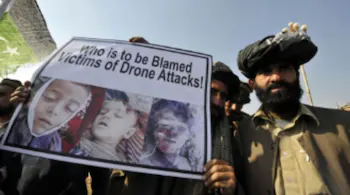
PESHAWAR — In a powerful show of unity and defiance, Pakistan Tehreek-e-Insaf (PTI), under the incarcerated leadership of Imran Khan, has announced its decision to lead a mass protest march to Islamabad alongside the grieving residents of Mir Ali. The move comes after a suspected drone strike killed four children and injured five others in the volatile North Waziristan town — and as public outrage increasingly turns toward the military establishment itself.
The protests, which erupted after the May 20 strike, have grown into a broader movement against what demonstrators call the “silence and complicity” of the Pakistan Army. The military’s delayed response and its vague claim that the Pakistani Taliban were behind the drone strike have only fueled public anger.
“If the Taliban carried out the strike, how did a drone enter, attack, and exit Pakistani airspace without military interception?” asked Mufti Baitullah, a prominent tribal elder in Mir Ali. “We are not just demanding answers — we are holding the state accountable.”
This protest is now being seen not only as a demand for justice but also as a rare and direct challenge to the country’s powerful military establishment. Chants of “We want justice” have given way to sharper slogans against the army’s failure to protect civilians, marking a critical moment in civil-military relations.
By aligning with the tribal communities, PTI has further intensified pressure on the military. “This is no longer about just one strike — this is about systemic failures and a growing disconnect between the people and the institutions meant to protect them,” said a senior PTI leader. The party has called for an independent inquiry, and its decision to take the protest to the gates of power in Islamabad underscores the political weight of the crisis.
Nayak Muhammad Dawar, a provincial minister, condemned the attack and confirmed an investigation is underway. But for the thousands marching — including grieving families and political activists — mere condemnations are no longer enough.
With the protest gaining momentum and anti-army sentiment on the rise, the coming days may prove critical for the military’s image and its ability to manage dissent within its own borders.(API)