













By | Kamran Ashraf Bhat
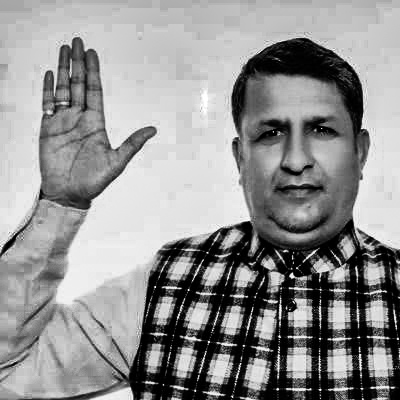
In the politically charged atmosphere of Jammu and Kashmir, where the announcement of Assembly elections has set the stage for intense power struggles, few stories are as captivating—or as telling—as the spectacular fall of Haji Farooq. Once a formidable figure in Lolab, Haji Farooq’s political career now lies in tatters, a casualty of his own hubris, the machinations of his party, and the unforgiving scrutiny of the public. His descent from a celebrated “man of the people” to a pariah in the political arena is a masterclass in how not to play the game of power.
As the election fever grips the Union Territory, political activities have surged to a crescendo. In every corner of Jammu and Kashmir, discussions about party mandates and potential candidates are the talk of the town. Amid this frenzy, the People’s Conference (PC), led by the shrewd and calculating Sajad Lone, has been methodically assessing its prospects in Lolab, a region once considered having decent voter base for the party. However, it quickly became apparent that the tide was turning against them. Haji Farooq, who once commanded respect and influence, was now seen as a liability—a man whose lackluster performance had eroded public confidence.
The decision by the People’s Conference to deny him a ticket for the Assembly elections was not just a tactical move; it was an indictment of Haji Farooq’s entire political career. The party’s leadership, recognizing the dwindling support in Lolab, concluded that his candidacy would only further alienate voters and tarnish the party’s reputation. In one swift stroke, Haji Farooq was cut loose, his ambitions crushed by the very institution he had served for years.
In a bid to salvage his reputation—or perhaps out of sheer desperation—Haji Farooq tendered his resignation. He claimed to be stepping down due to “ideological differences, as well as internal and external undue interference in the party.” At first glance, this statement might seem like a principled stand. But a closer examination reveals the hollowness of his words. For nearly three years, Haji Farooq enjoyed the trappings of power as the Vice Chairman of the District Development Council (DDC), a position he attained after joining the People’s Conference as an independent DDC member. During this period, he was conspicuously silent about any “ideological differences.” He made no public statements criticizing the party’s direction, nor did he express any dissent. On the contrary, he reveled in the privileges of his office, his government vehicle proudly bearing the title “Vice Chairman DDC,” a symbol of his status and influence.
But now, with his political career on the ropes, Haji Farooq’s sudden invocation of ideology rings hollow. It’s a transparent attempt to rewrite the narrative, to portray himself as a man of principle rather than a political opportunist. The reality, however, is that Haji Farooq’s career has been marked by a series of opportunistic moves, each designed to keep him in power, regardless of the ideological cost. This is a man who, not long ago, was a loyal foot soldier of the Congress party, waving its flag with fervor and proclaiming his undying commitment to its principles. Yet, when the winds of political fortune shifted, he was quick to abandon the Congress, reinventing himself as an independent candidate before ultimately throwing in his lot with the People’s Conference.
Haji Farooq’s journey through the political landscape of Jammu and Kashmir is a textbook example of the kind of opportunism that has long plagued South Asian politics. In this part of the world, political affiliations are often as disposable as the promises made during election campaigns. Politicians switch parties with the same ease as changing clothes, each shift driven not by ideology, but by the pursuit of power and the perks that come with it. For decades, this pattern of political prostitution went unpunished, with voters seemingly resigned to the idea that all politicians were cut from the same cloth.
But times are changing. The last Central election in India sent a clear message: the electorate is growing increasingly weary of politicians who treat party loyalty as a mere convenience. Those who have made a career out of switching sides, of jumping from one party to another in search of the next big opportunity, are now facing the wrath of voters. The once-unassailable Haji Farooq is now finding himself on the wrong side of this new political reality.
What makes Haji Farooq’s downfall particularly compelling is the sheer audacity with which he has conducted himself over the years. Here is a man who, as an independent DDC member, quickly aligned himself with the People’s Conference the moment it became clear that this was his ticket to power. For years, he basked in the glory of his position, using his status to settle scores and indulge in petty vendettas. His behavior became increasingly erratic and arrogant, with numerous accounts of him flaunting his official protocol, reveling in the attention it brought. He would often be seen in a video recorded his driver while driving him around, a move that many saw as the height of vanity and care least for law.

But the true measure of Haji Farooq’s political failure lies in the sentiments of those who once supported him. In conversations with his constituents—many of whom had never before participated in elections, but who rallied behind him when he ran as a DDC member—a sense of profound disappointment emerges. These voters, who placed their hopes and trust in Haji Farooq, now feel betrayed. They describe him as a man who lacks true leadership qualities, someone who is more interested in settling scores than in serving the public good. Government employees, in particular, have voiced their grievances, allegedly accusing Haji Farooq of using his position to retaliate against those who refused to toe his line.
The resentment against Haji Farooq has been building for some time, fueled by his arrogance and his penchant for lashing out at anyone who dared to challenge him. His downfall is not just the result of a political miscalculation; it is the inevitable consequence of years of arrogance, vindictiveness, and a complete disregard for the principles he once claimed to uphold.
For students of politics, the story of Haji Farooq offers a rich case study in the perils of unchecked ambition. Here is a man who rose to prominence by portraying himself as a humble servant of the people, only to be undone by the very qualities that he tried so hard to conceal—his thirst for power, his vindictive nature, and his utter lack of genuine ideological conviction.
Haji Farooq’s transformation from a respected leader to a political pariah is a cautionary tale for all who seek power for its own sake. It is a reminder that in the ever-evolving landscape of South Asian politics, those who prioritize personal gain over the public good will eventually face the consequences. His story is not just about the rise and fall of one man; it is a reflection of the broader shifts taking place in the region, where voters are increasingly unwilling to tolerate the kind of political opportunism that has long defined the status quo.
As Haji Farooq faces the twilight of his political career, one can only wonder what the future holds for him. Will he attempt yet another reinvention, another desperate bid for relevance? Or will he finally confront the reality of his own undoing? Only time will tell, but one thing is certain: the days of political chameleons like Haji Farooq are numbered. The electorate is waking up, and those who fail to heed this new reality do so at their own peril.
Note: The views expressed in this article are the personal opinions of the writer.